
PlantChapters documents institutional plant-based food transitions using a structured system designed to make institutional change easier to understand, compare, and replicate.
Five connected layers
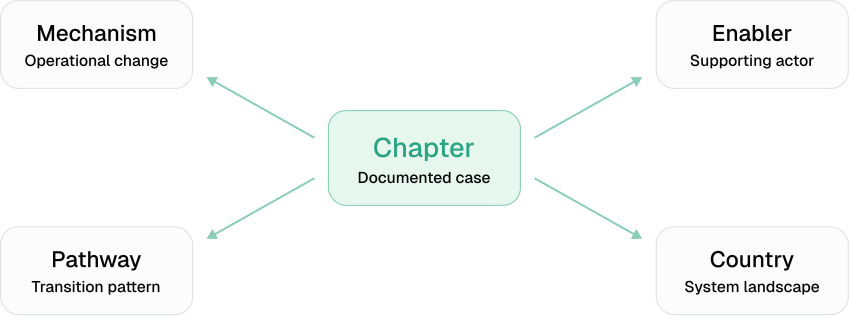
PlantChapters is organised into five connected layers:
Chapters
Documented institutional cases, policy developments, infrastructure models, and transition examples.
Mechanisms
Operational changes used to shift institutional food systems, such as default switches, procurement reform, and menu redesign.
Pathways
Patterns describing how institutional change enters or spreads through systems.
Enablers
Organisations, programmes, and actors repeatedly supporting institutional transitions across multiple cases.
Countries
National and regional transition landscapes, including infrastructure, policy environments, adoption patterns, and strategic gaps.
The layers are interconnected. Chapters connect to mechanisms, pathways, enablers, and countries to make patterns and relationships easier to identify across the system.
How to use this resource
PlantChapters can be explored from multiple entry points depending on the question being asked.
School food operator
Explore school-related chapters, procurement mechanisms, and national policy environments to identify operational models already in use.
Researcher or journalist
Compare pathways, mechanisms, and adoption patterns across countries and institution types.
Transition strategist
Identify recurring patterns in how institutional transitions emerge, spread, and scale across different settings.
NGO or advocacy organisation
Identify enabling infrastructure, recurring operational barriers, and high-replication institutional models.
Policymaker
Explore procurement frameworks, institutional mandates, and large-scale public food system transitions.
Institutional transitions are rarely isolated
Most institutional food transitions do not happen through a single decision or policy.
They emerge through combinations of:
- operational mechanisms,
- enabling organisations,
- institutional pathways,
- procurement systems,
- and broader national infrastructure.
PlantChapters documents these relationships as connected systems rather than isolated case studies.
Key Definitions
Chapter Families define the structural type of implementation being documented. Not all Chapters represent the same kind of institutional change.
Some Chapters document institutions changing their food systems directly. Others document the infrastructure, coalitions, or founding models that support institutional transition more broadly.
It helps distinguish:
- operational transitions,
- system infrastructure,
- coalition models,
- and founding-based approaches.
This taxonomy includes:
Transition
A single institution or system changes its own food operations toward a more plant-based model. This is the most common Chapter Family in the dataset and includes operational changes such as menu redesign, procurement reform, default switches, or ingredient substitution within an existing institution.
Infrastructure
An organisation, programme, or platform builds systems that make institutional transition easier for other institutions. Infrastructure Chapters do not primarily document one institution changing itself — they document enabling capacity, tools, training systems, procurement frameworks, or implementation models that support broader transition.
Network-Coalition
Multiple institutions coordinate around a shared commitment, covenant, pledge, or collaborative framework. Change occurs through collective participation rather than through a single institution acting alone.
These Chapters are structurally important because they can influence many institutions simultaneously while allowing local implementation flexibility.
Founding
An institution is designed around plant-based principles from inception rather than transitioning later from an animal-product-based system. The operational model is embedded into the institution’s structure from the beginning.
Founding Chapters are analytically distinct because they avoid many of the resistance dynamics associated with retrofitting existing systems.
Entry Points describe how plant-based food implementation first enters an institution. They identify the initiating actor, department, or pressure point that begins the transition process.
An Entry Point is not the mechanism itself (for example, a Default Switch or Procurement Reform). It describes where the implementation originated operationally.
This taxonomy includes:
Student union
An implementation initiated through student governance structures, campaigns, or democratic processes within a university or higher education institution. Student unions often use motions, referendums, food service oversight, or venue control to influence institutional catering systems.
Procurement team
An implementation initiated through purchasing, sourcing, or contract management functions within an institution. Procurement teams influence food systems by modifying supplier requirements, contract specifications, ingredient standards, or purchasing criteria.
Sustainability office
An implementation initiated through institutional sustainability, climate, or environmental strategy teams. These offices typically frame plant-based transition through emissions reduction, net-zero targets, ESG reporting, or sustainability commitments.
Caterer / operator
An implementation initiated by a food service provider, catering company, or contract operator managing food systems across one or multiple institutions. The operator drives implementation through menu redesign, procurement shifts, or system-wide operational changes.
Government department
The implementation is initiated directly through a national, regional, or local government body acting within its own operational authority. This includes departments responsible for education, health, procurement, agriculture, or public food programmes.
NGO partner
The implementation is initiated or operationally enabled by a non-governmental organisation working directly with institutions. NGOs typically provide implementation support, training, menu development, procurement guidance, or behavioural strategy.
Founder
The implementation originates from the founder or original leadership vision of an institution designed around plant-based principles from inception, rather than converted later through transition.
Clinical leadership
The implementation is initiated through medical, dietetic, or healthcare leadership within an institution. Clinical leaders typically frame transition through patient outcomes, chronic disease prevention, nutrition standards, or healthcare system performance.
Chef
The implementation is initiated through culinary leadership within an institution or operator network. Chefs influence transition through recipe development, menu redesign, ingredient substitution, and kitchen culture change.
Research institution
The implementation is initiated through academic research, evidence generation, or pilot studies produced by universities, think tanks, or research bodies. Research institutions often provide the evidence base that enables operational rollout or policy adoption.
Municipal food office
The implementation is initiated through a dedicated city or regional food policy office coordinating institutional food strategy across multiple public systems. These offices often connect procurement, sustainability, public health, and education functions.
Elected representatives
The implementation is initiated through elected officials such as councillors, legislators, ministers, or political representatives using formal political authority to introduce motions, legislation, procurement mandates, or policy reforms.
Academic champion
The implementation is initiated by an influential academic, lecturer, researcher, or university staff member advocating internally for institutional food transition. Unlike Research Institution, this entry point is driven by an individual actor rather than a formal research infrastructure.
Civil society / advocacy campaign
The implementation is initiated through external public pressure, grassroots organising, petitions, advocacy networks, or coordinated civil society campaigns. These campaigns often create the political or cultural conditions that enable institutional change.
Scale Category describes the operational reach of an implementation. Some Chapters affect a single institution, while others reshape procurement systems, public infrastructure, or implementation models across entire regions or countries.
It helps distinguish:
- local implementation,
- multi-site operational change,
- municipal coordination,
- national systems,
- and infrastructure capable of influencing future transitions at scale.
This taxonomy includes:
Site
The implementation affects a single institution or location. Operational change is contained within one defined site, even if the institution itself is large.
Multi-site
The implementation operates across several institutions, campuses, facilities, or locations simultaneously under a shared implementation model or operator structure.
Municipal-regional
The implementation affects a city-wide or regional system involving multiple institutions, departments, or public programmes within a defined geographic area.
National
The implementation operates at country scale through national legislation, procurement standards, public programmes, or system-wide implementation frameworks.
International
An implementation operating across multiple countries through a single organisation, operator, programme, or network. International chapters implement food system changes across a geographically distributed set of locations rather than within a single country.
System infrastructure
The Chapter documents infrastructure capable of enabling future implementations across many institutions beyond a single implementation site or geography. These Chapters typically build operational capacity, implementation models, procurement systems, or transition frameworks that other institutions can adopt.
Replication Difficulty estimates how accessible an implementation model is for other institutions attempting to implement something similar. Some transitions can be adopted quickly with minimal structural change, while others depend on political conditions, specialised infrastructure, long implementation timelines, or unusually strong institutional alignment.
It evaluates the practical difficulty of reproducing the model — not whether the transition was successful.
This taxonomy includes:
Low
The implementation can be replicated by most institutions using existing operational structures, modest resources, and relatively limited coordination. Implementation typically requires minimal political or infrastructural change.
Low-medium
The implementation remains broadly accessible but requires moderate operational coordination, leadership support, or limited infrastructure adaptation. Replication is realistic for many institutions, though not immediately frictionless.
Medium
The implementation requires significant coordination, operational capability, stakeholder alignment, or procurement restructuring. Replication is achievable but depends on favourable institutional conditions and sustained implementation effort.
Medium-high
The implementation depends on substantial political support, organisational capacity, specialised infrastructure, or multi-stakeholder coordination. Replication is possible but structurally difficult for most institutions without strong enabling conditions.
High
The implementation relies on unusually favourable structural conditions, large-scale infrastructure, national policy authority, exceptional leadership alignment, or highly specific contextual factors. Replication is difficult outside a limited number of institutional environments.
Speed Category describes how quickly an implementation moved from initiation to operational implementation. Some institutional changes happen within weeks through direct operational decisions, while others require years of procurement cycles, infrastructure development, stakeholder coordination, or policy reform.
It helps distinguish:
- rapid implementation,
- gradual institutional transition,
- long-term structural development,
- and institutions designed plant-based from inception.
This taxonomy includes:
Immediate
The implementation moved from initiation to implementation in under one month. These cases typically involve direct operational control, limited structural resistance, or highly contained implementation environments.
Fast
The implementation was implemented within approximately one to six months. These Chapters usually involve moderate coordination but avoid major procurement restructuring, infrastructure development, or legislative processes.
Moderate
The implementation developed over approximately six months to two years. This is the most common implementation range for institutional transitions involving operational redesign, stakeholder engagement, pilot phases, or phased rollout.
Slow
The implementation required approximately two to ten years to reach operational implementation. These Chapters typically involve complex institutional systems, long procurement cycles, political negotiation, infrastructure development, or gradual sequencing strategies.
Foundational
The institution was designed around plant-based principles from inception rather than transitioning from an existing operational model. There is no defined transition timeline because the plant-based structure existed from the beginning.
Implementation Status describes the current operational state of an implementation. Not all Chapters represent a fully stable or completed implementation. Some remain in pilot phases, others have received policy approval without operational rollout, and some have weakened or been discontinued over time.
It helps distinguish operational reality from announcements, intentions, or temporary implementation phases.
This taxonomy includes:
Implemented
The implementation is operational and actively functioning within the institution or system being documented. The documented mechanism is currently in place beyond a pilot or announcement stage.
Pilot Underway
The implementation is being tested through a limited implementation phase before wider rollout or permanent adoption. Pilots are operational but remain structurally provisional.
Policy Approved
The implementation has received formal institutional, political, or administrative approval but has not yet entered full operational implementation.
Pending Rollout
The implementation is planned and scheduled for implementation, but operational changes have not yet begun or remain incomplete.
Degraded
The implementation remains partially active but has weakened in scope, consistency, political support, operational quality, or implementation depth compared to its original form.
Discontinued
The implementation has ended and is no longer operational within the institution or system being documented.
End Status describes the current timeline state of an implementation. Some Chapters represent ongoing operational programmes, while others reached a defined conclusion or document infrastructure models with no natural endpoint.
It helps distinguish:
- active transitions,
- completed implementation phases,
- and long-term structural infrastructure.
This taxonomy includes:
Ongoing
The implementation remains operational and active at the time of documentation. The implementation continues without a defined endpoint.
Completed
The implementation reached a defined operational endpoint, pilot conclusion, implementation phase, or programme completion. The Chapter documents a completed sequence rather than an actively evolving implementation.
Structural
The Chapter documents infrastructure, systems, or institutional models designed for indefinite operation rather than for a time-bound implementation process. These Chapters typically have no meaningful operational end date.
Help keep this resource accurate
If you notice inaccurate, incomplete, or outdated information, you can submit a suggested update for review.